Our latest guide is here to provide you with a low-risk way to review and upgrade your compliance support. Just click below to download your free copy.
Download here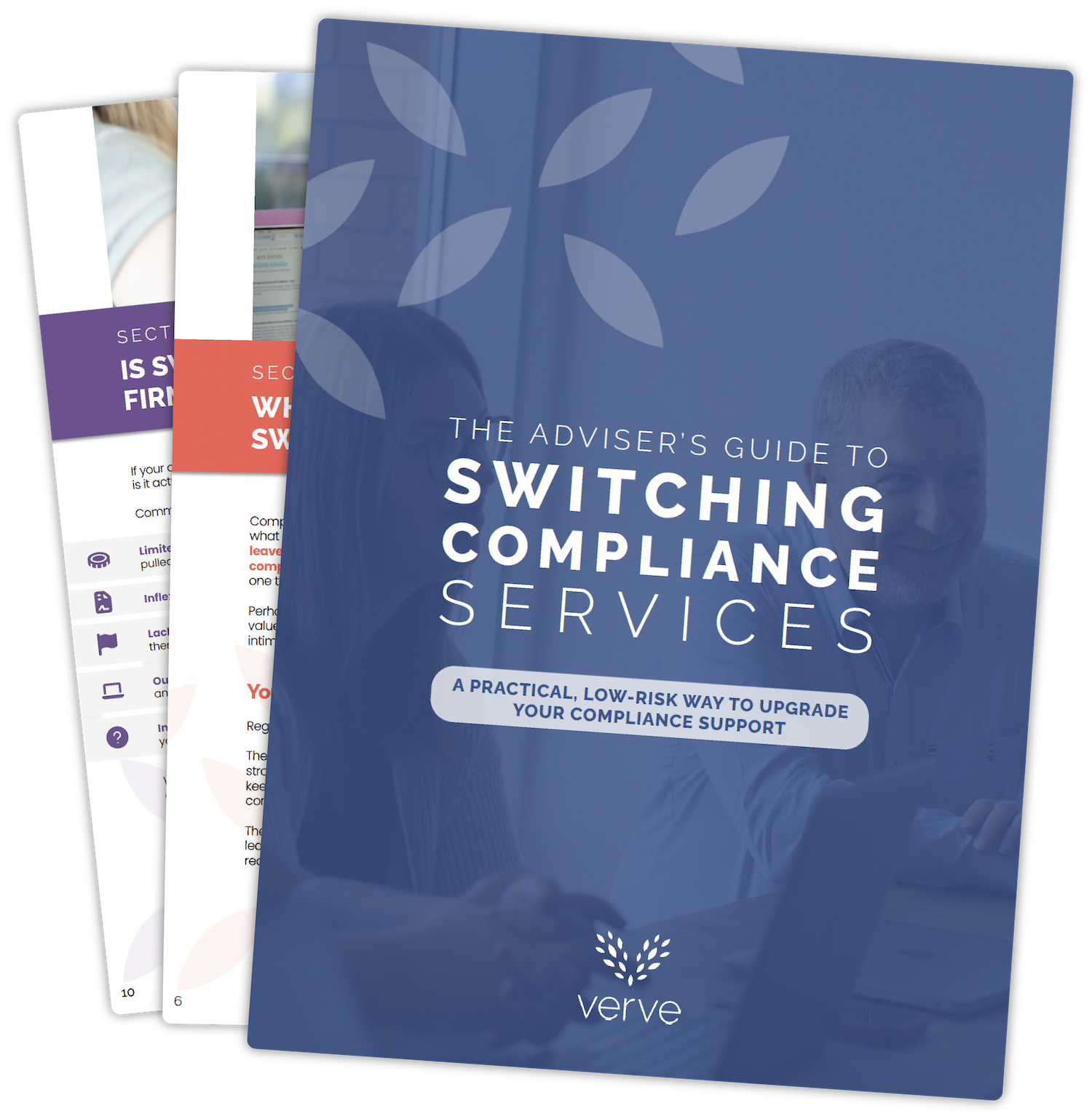
Poor compliance usually isn’t the problem. Adequate compliance is!
Advice firms don’t go out in search of poor compliance. Rather, compliance relationships drift into place: the provider meets minimum requirements, nothing has gone seriously wrong, and the firm stays authorised.
Over time, good enough becomes the default because ‘that’s just always the way compliance has been.’
But as regulatory expectations grow and advice firms become more complex, what once was tolerable becomes a constraint. ‘Good enough’ compliance drains time, limits confidence and slows progress.
Here, we’re exploring the 4 reasons so many advisers tolerate underwhelming compliance support, and why reassessing it can be a far lower risk solution than many assume.
This is the most common reason advisers tolerate underwhelming compliance.
Compliance:
That makes it easy to let it fade into the background, especially when firms are busy serving clients and growing organically.
But “not broken” isn’t the same as fit for purpose. As firms scale, introduce new services or navigate Consumer Duty expectations, compliance needs to evolve too. When it doesn’t, friction builds quietly in the background.
The takeaway: Stability can mask stagnation.
Compliance feels different to other services because the stakes feel higher.
Many advisers worry that changing compliance support could:
Even if those risks are unlikely, the perception alone is enough to discourage action.
As a result, firms stick with what they know. Not because the service is strong, but because it feels safer than change.
The takeaway: Familiarity often feels safer than improvement.
Another widely held belief is that switching compliance must be:
And lots of firms assume it involves:
In reality, switching doesn’t have to look like this, but without visibility of how it works, advisers default to inaction.
The takeaway: The perceived cost of switching often outweighs the real cost.
For lots of advisers, compliance has never been positioned as something that adds value.
Instead, it’s been:
Over time, this creates a culture where:
When compliance feels like a necessary evil, expectations stay low, so “meh” becomes acceptable.
The takeaway: Low expectations lead to low returns.
Tolerating poor or underwhelming compliance rarely causes immediate failure — but it does create problematic friction.
That friction looks like:
Over time, this limits productivity, confidence and momentum. What feels manageable short term can be costly long term.
Advisers don’t tolerate underwhelming compliance because they don’t care. They do it because change feels unnecessary, risky or disruptive.
But in a more demanding regulatory environment, compliance needs to do more than just meet minimum standards. It should provide clarity, confidence and control, not something you work around or worry about at audit time.
If the concerns we’ve outlined here feel familiar, you’re not alone. It may be time to explore whether it’s still serving your business as well as it could.
Our Adviser’s guide to switching compliance services addresses the most common fears advisers have about changing compliance support.
You can download it for free to see step by step how switching works – head straight to the ‘myth busting’ section for a look at improving compliance without disruption, downtime or necessary risk.

Darren is chief commercial officer at Verve, with an extensive background in finance as a sales director, financial planner and T&C supervisor.

.png)
.png)