
Our latest guide is here to provide you with a low-risk way to review and upgrade your compliance support. Just click below to download your free copy.
Download here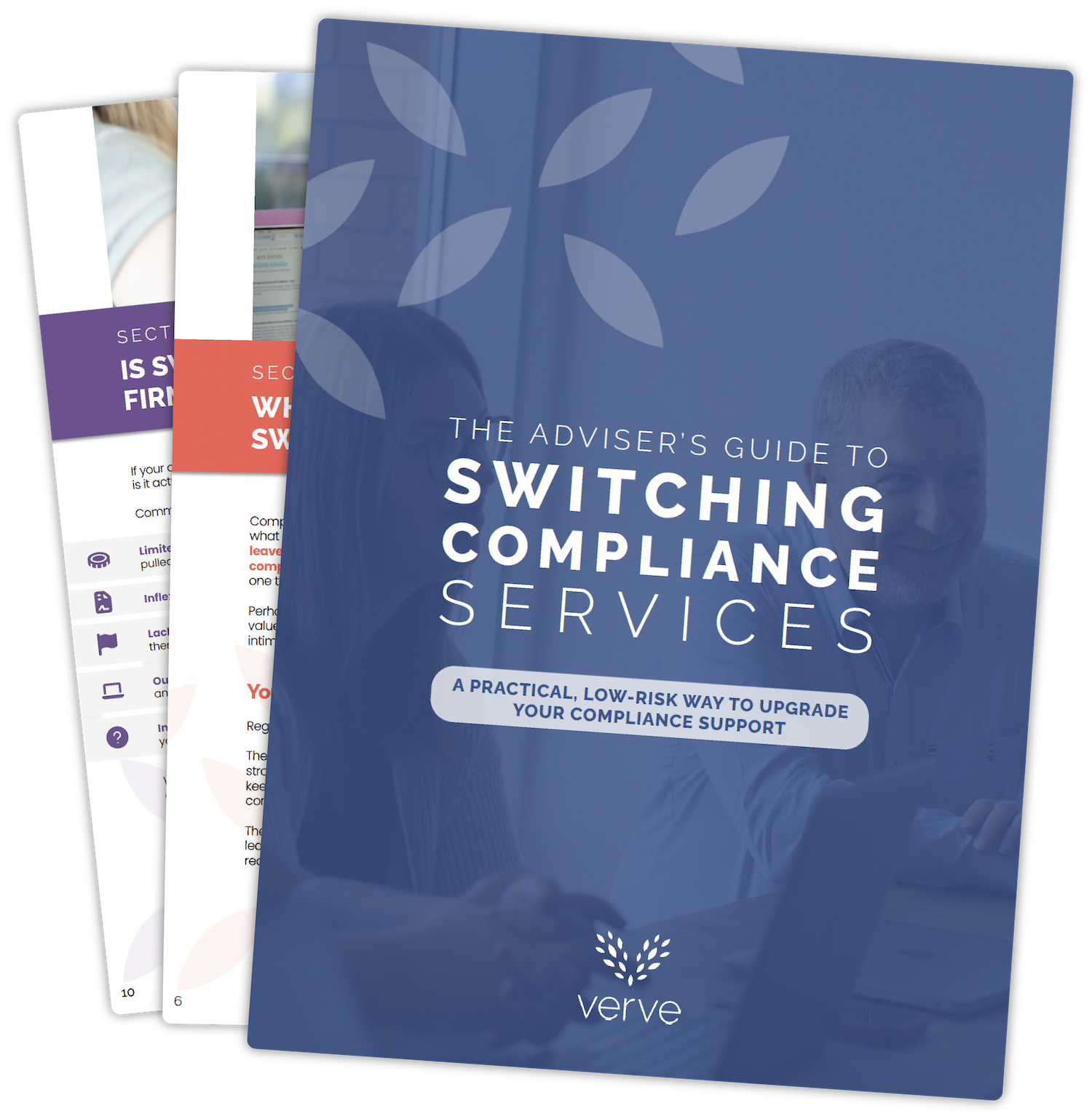
Can an advice firm use just one provider for both paraplanning and compliance? It’s a very good question.
There’s a strong chance your paraplanning and compliance processes already overlap: one team writes the advice, another checks it and sends back amends – and so it goes, back and forth sometimes multiple times.
And we love a bit of healthy challenge! But if the challenge becomes friction, and the friction becomes a bottleneck, the disconnect between the teams is now an operational problem.
Connecting paraplanning and compliance under one provider is a good way to beat the bottleneck, but only if you choose carefully.
Here are the 5 benefits firm leaders should look for before making the switch.
Firms who’ve already made the compliance switch say unnecessary rewrites is one of the biggest frustrations for advisers.
This doesn’t always happen because the advice is wrong; more often it’s because the paraplanner and compliance reviewer are approaching the case from different operational mindsets.
When paraplanning and compliance teams work closely together, there’s usually:
It means a smoother experience for advisers, admins and ultimately clients too.
Lots of firms are already juggling multiple systems, providers and processes, so switching to one provider for paraplanning and compliance should simplify:
Plus, your provider should develop a deeper understanding of how your business operates, your advice style and client proposition, making them feel truly part of your team, not an add-on.
It goes without saying that good compliance should protect firms and clients. Consultants should also understand the reality of delivering financial advice for a busy firm.
When compliance operates in complete isolation from the advice process, feedback can sometimes feel overly theoretical or disconnected from practical adviser outcomes.
So, a joined-up approach should create more commercially-aware conversations without compromising standards.
This is the big one. If the same company writes the advice and signs off the compliance, how can the review remain objective - surely that creates a conflict of interest?
The answer depends entirely on how the provider is structured.
As an example, at Verve, our paraplanning and compliance teams are completely separate functions. The compliance team is not “marking its own homework”, and files still go through robust independent challenge and review processes.
But while the functions are separate, their philosophy is aligned – we call it the ‘Verve view’.
All of our teams work from the same underlying principles:
Our shared understanding makes a huge difference, allowing compliance feedback to feel more connected to the advice process while maintaining proper oversight and independence.
This isn’t always the case and it’s something to check.
Some providers are excellent paraplanners but weaker on compliance capability, and vice versa.
That’s why we suggest firm leaders look beyond the convenience factor and assess a potential combined provider for:
There’s no reason to compromise when there’s a provider out there that’s a good fit for your firm, and great at both (hint: you’re already on their website).
Potentially, yes!
But only if the provider can deliver both proper independent challenge and alignment across teams. That’s how firms leave unnecessary friction behind in favour of fewer rewrites, smoother processes and better experiences for advisers and clients.
If you're currently experiencing bottlenecks between paraplanning and compliance, it might be time to rethink whether your existing setup is helping or hindering the process.
We recently launched our free Compliance Switching Guide, which walks through:
Download the guide here and explore what a smoother compliance process could look like for your firm. Or, book a chat with a member of the team here.

.png)

.png)
.png)
.png)
.png)